


Why Spine Problems Can Cause Pain Beyond Your Back
One of the most confusing aspects of musculoskeletal pain is that the area that hurts is not always the area that's experiencing an issue. Often, what feels like a problem in the arm, leg, or shoulder may actually originate in the spine.
The spine contains and protects the spinal cord, a complex network of nerves that carry signals between the brain and nearly every part of the body. When the spinal cord becomes irritated or compressed by conditions such as herniated discs or arthritis, symptoms can develop along certain nerve pathways, causing pain far from the neck or back. If you've noticed pain or other symptoms in your arms, legs, hips, or feet that don't seem to have a clear cause, don't ignore them. Instead, schedule an evaluation to identify whether your spine is playing a role in your pain and what your options are for lasting relief.
How the Spine Connects the Brain to the Body
We often think of the brain as separate from the rest of the body. However, the cells that make thinking, feeling, doing, and all aspects of living possible are not confined to the brain. Neurons, which are specialized cells that gather, process, and send information, can be found throughout the body. Outside the brain, neurons are organized into nerves — fibrous strands that reach almost every corner of the body.
The information that nerves carry from the body to the brain, and vice versa, can take many forms. This can include cues that trigger sensations such as touch, taste, smell, and sight, as well as signals that tell our muscles to contract for conscious actions like walking, grasping, and chewing, and automatic actions, such as heartbeat, breathing, and digestion. Nerves also relay information indicating that something is wrong within our bodies, transmitting signals related to injury and inflammation, which is then often felt as pain.
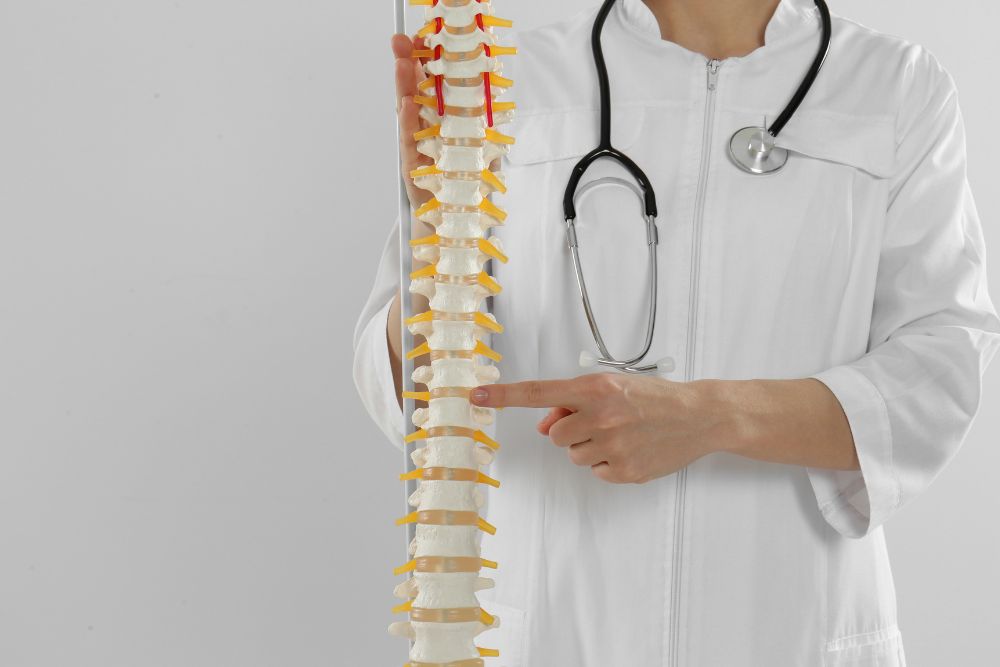
Nerves originate from the spinal cord, a column of neural tissue that stretches from the brainstem to the lower back. The cord passes through a central opening in each vertebra of the spine, and as these bones stack on top of one another, their openings align to form a continuous protective channel called the spinal canal. At each vertebra, nerve roots branch off from the spinal cord and extend outward to the shoulders, arms, hands, hips, legs, and feet.
How Spinal Conditions Affect the Nerves
To protect the spinal cord while still allowing for movement, additional structures sit between each vertebra. These include:
- Discs, which are tissues with a tough outer layer and a soft, gel-like center that cushion the ends of each vertebra to help absorb shock during everyday activities
- Facet joints at the rear of each vertebral pair to allow for controlled, stable motion
- Ligaments and surrounding soft tissue to help maintain proper alignment
Over time, or following an injury, these structures can break down and irritate the nerve roots that stem from the affected vertebrae.
Common Examples of Spine-Related Pain
As we age, intervertebral discs can dry out and lose height, narrowing the space between vertebrae and compressing the nerve roots that pass through them, a condition known as spinal stenosis. Without adequate cushioning, vertebrae can also begin to rub against each other, prompting the body to produce additional bone that grows into the spinal canal, putting pressure on the spinal cord.
Disc degeneration can also cause its outer layer to weaken, allowing for the soft inner material to bulge outward and press directly against a nerve root. This is known as a herniated or “slipped” disc, which can also result from injury.
In the same way intervertebral discs can begin to break down with age, so can the cartilage between the vertebrae’s facet joints. As the cartilage deteriorates, facet joints begin to rub against each other, resulting in inflammation and swelling that can also compress the nerves. This is known as facet-joint arthritis.
Why Spine Problems Cause Symptoms Elsewhere
A compressed nerve root sends signals along the entire pathway it controls, producing pain, numbness, tingling, or weakness in whatever region that nerve supplies.
For example, issues affecting the cervical spine, which refers to vertebrae in the neck, can cause symptoms in the shoulders,arms, and hands. This can even include pain that travels to the skull, causing headaches.
Problems in the lumbar spine, the lower portion of the back, most commonly affect the hips, buttocks, and legs. Sciatica is one of the most recognizable examples. When the sciatic nerve, which runs from the lower back through the hip and down each leg, becomes compressed, it can produce a sharp, shooting pain that follows the nerve's path, sometimes reaching all the way to the foot.
Localized Pain vs. Radiating Pain
Most of us are familiar with localized pain, which is confined or restricted to a particular area of injury, such as a pulled muscle. Pain typically arises from movement or pressure applied to that specific area, and tends to resolve as the tissue heals.
What differentiates nerve pain from other types of pain is that it radiates away from its source. It also often has a sharper or more electric quality and may be accompanied by tingling, burning, or weakness. It can worsen with positions or movements that increase pressure on the affected nerve, and it does not necessarily come with any pain at the spine itself.
Radiating pain can sometimes be confused with referred pain, which also occurs away from the source, but does not follow a nerve path.
Recognizing whether pain is localized, radiating, or referred is often an important step in understanding what may be causing symptoms.
Why Getting the Right Diagnosis Matters
When symptoms appear in the arm, leg, or another area, the natural tendency is to focus treatment on where the pain is felt. But if the underlying cause is a compressed nerve root in the spine, addressing only the symptomatic area rarely resolves the problem. Treatment aimed at the wrong location may provide temporary relief at best, while the actual source continues to worsen.
At Visco Spine & Joint Center, identifying the source of pain is where every treatment plan begins. Our board-certified physicians and practitioners use advanced diagnostic tools to determine whether symptoms in the arms, legs, or elsewhere are rooted in a spinal condition. From there, we work with you to develop a personalized, non-invasive treatment plan that provides long-lasting relief without surgical intervention. If you've been dealing with pain that hasn't responded to treatment or doesn't seem to have a clear cause, request an appointment at one of our locations in Hoboken, Jersey City, Wyckoff or Bayonne.